
Undermount sinks are a popular choice for kitchens and bathrooms because they create a clean, seamless look and make wiping water and debris directly into the sink easier.
However, installing an undermount sink on 2CM quartz is different from installing one on 3CM quartz. The countertop thickness affects how the sink is supported, whether plywood underlayment is needed, and what type of mounting hardware can safely be used.
Understanding these differences before installation can help prevent cracked countertops, loose sinks, and unnecessary repairs.
1. What's the Difference Between 2CM and 3CM Quartz?
Quartz countertops typically come in two common thicknesses:
2CM quartz (approximately 3/4 inch): Thinner and lighter, often requiring additional support depending on the cabinet construction and manufacturer's specifications.
3CM quartz (approximately 1 1/4 inches): Thicker and more rigid, typically installed directly over properly supported cabinets without a full plywood underlayment.
Both thicknesses can accommodate undermount sinks, but their installation requirements may differ significantly.
2. Installing an Undermount Sink on 2CM Quartz
With 2CM quartz, proper support is especially important because the slab is thinner.
Using Plywood Underlayment
A common installation method involves placing a plywood underlayment board on top of the cabinets before setting the quartz countertop.
Depending on the quartz manufacturer's specifications and cabinet construction, installers may use 5/8-inch or 3/4-inch plywood, although other support configurations may be approved.
The underlayment helps:
Provide a stable, level surface beneath the quartz.
Distribute the countertop's weight across the cabinets.
Reinforce areas surrounding sink and cooktop cutouts.
Provide an attachment surface for certain sink-support brackets.
Important: The plywood must be properly secured to the cabinet structure, and the sink opening must leave enough room for the sink flange and mounting hardware. Exposed plywood edges around the sink should also be protected against moisture.
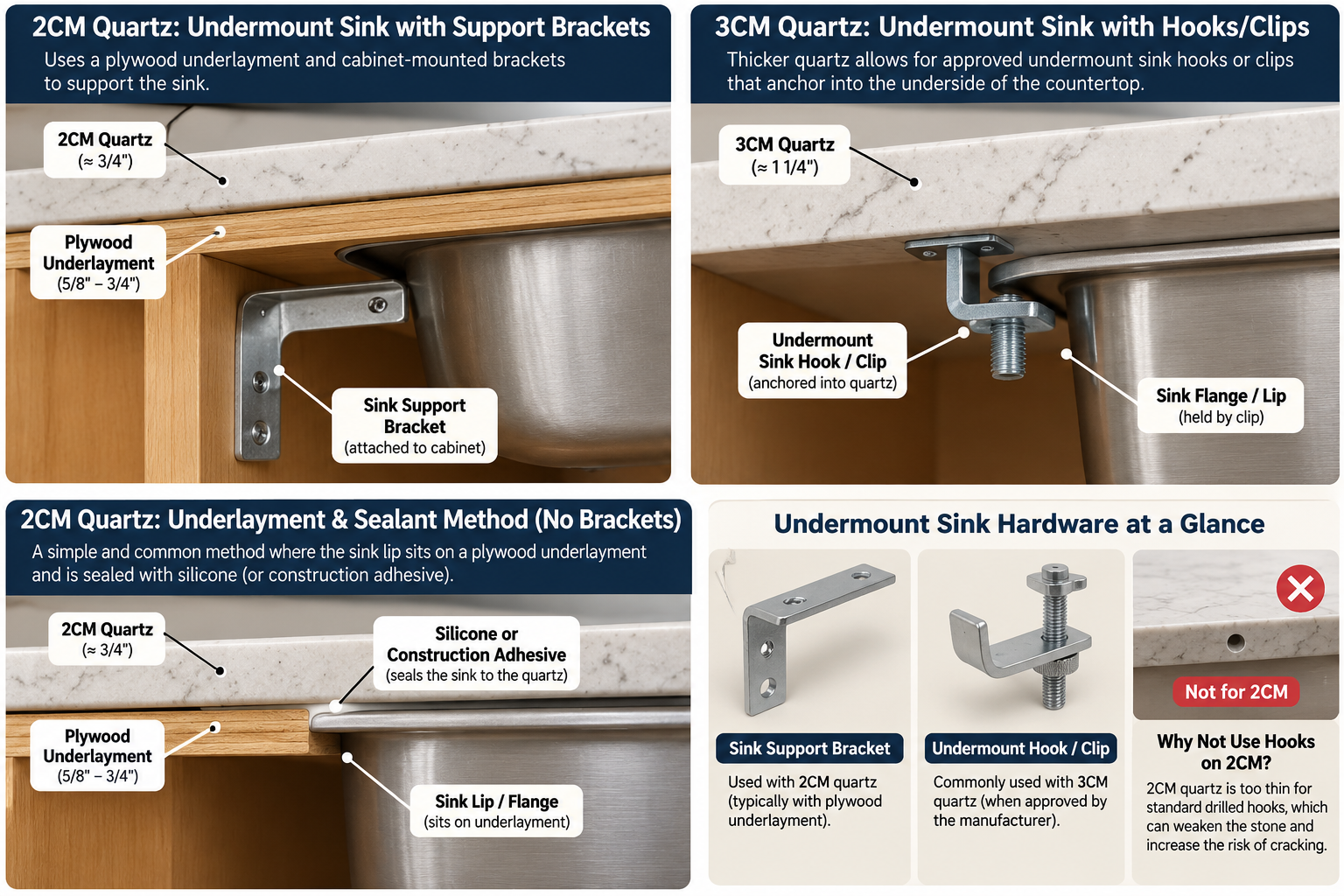
Showcasing image of 2cm quartz vs 3cm quartz with undermount sinks with and without brackets
Why Standard Sink Hooks May Not Work on 2CM Quartz
Some undermount sinks are secured using metal hooks or clips attached to anchors installed in the underside of the countertop.
The challenge with 2CM quartz is its limited thickness.
Drilling into a thin quartz slab to install conventional anchors can increase the risk of cracking, weakening the material, or accidentally drilling too deeply.
For this reason, standard drilled hooks intended for thicker stone should not automatically be used on 2CM quartz.
Instead, installers may use:
Brackets secured to an appropriate plywood underlayment.
Sink-support rails attached to the cabinet walls.
Adjustable sink-support frames or cradles.
Specialized mounting clips approved for the particular 2CM quartz product.
The correct method depends on the sink's weight, cabinet construction, and countertop manufacturer's guidelines.
3. Installing an Undermount Sink on 3CM Quartz
Because 3CM quartz is thicker, it generally provides greater rigidity around the sink opening.
In many installations, 3CM quartz can sit directly on properly leveled and supported cabinets without requiring a full plywood underlayment.
Using Undermount Sink Hooks and Clips
For some 3CM quartz products, fabricators can use approved mechanical anchors and undermount sink clips to secure the sink beneath the countertop.
These clips grip the sink's mounting flange and help hold it firmly against the underside of the quartz.
However, not every quartz manufacturer permits drilling or fastening clips directly into its slabs. Some require alternative support methods, even for 3CM countertops.
Always follow the specific manufacturer's installation requirements rather than assuming that thicker quartz can safely accept any type of hook.
4. Why Proper Sink Support Matters
An undermount sink must support more than its own weight.
Consider a kitchen sink filled with water, heavy cookware, and dishes. Add a garbage disposal underneath, and the total load can become substantial.
Without adequate support, the sink may gradually separate from the countertop, creating gaps, leaks, or damage to surrounding cabinetry.
Silicone sealant alone should never be relied upon to hold an undermount sink in place.
Silicone is primarily used to create a watertight seal between the sink flange and the countertop. Proper mechanical support, such as compatible clips, brackets, or cabinet-mounted rails, is essential.
Heavier sinks, including fireclay, cast iron, and some composite models, may require additional support structures attached directly to the cabinetry.
5. Common Installation Mistakes to Avoid
Whether you're working with 2CM or 3CM quartz, these are some important mistakes to avoid:
Skipping necessary underlayment: Thin quartz may require additional structural support, especially near sink openings.
Using the wrong hooks: Installing anchors that aren't rated for the countertop thickness can damage the quartz.
Relying only on adhesive: Silicone creates a seal but isn't a substitute for structural sink support.
Ignoring sink weight: Heavy sinks and garbage disposals may need additional cabinet-mounted supports.
Failing to plan ahead: Plywood thickness, sink dimensions, mounting hardware, and countertop height should all be accounted for before installation.
6. Which Quartz Thickness Should You Choose?
Both 2CM and 3CM quartz can create beautiful, durable countertops when installed correctly.
2CM quartz can be a great option for homeowners who prefer a thinner profile or are working with a particular countertop design. Just remember that the installation may require additional underlayment or sink-support hardware.
3CM quartz offers a thicker profile and generally requires less supplemental countertop support. It can also provide more flexibility with certain mounting systems, depending on manufacturer approval.
Ultimately, the right choice depends on your kitchen design, cabinet construction, sink selection, and installation requirements.
Find Quartz Countertops and Kitchen Cabinets in Beaverton, Oregon
At Beaverton Kitchen Cabinets & Stone, we offer kitchen cabinets and countertop materials for homeowners, contractors, and remodeling professionals throughout the Portland metro area.
Whether you're remodeling your kitchen, replacing an undermount sink, or planning a new bathroom vanity, understanding your countertop's installation requirements can help you avoid costly mistakes.
Visit our showroom or explore our available cabinets and countertops at www.beavertoncabinets.com.
Please note: Beaverton Kitchen Cabinets & Stone supplies materials but please call in to ask if you would like us to install (depends on the complexity and if our new team can do it. If not, we will not take the job). Countertop fabrication, sink mounting, and installation should be completed by qualified professionals following the applicable manufacturer's instructions.

